
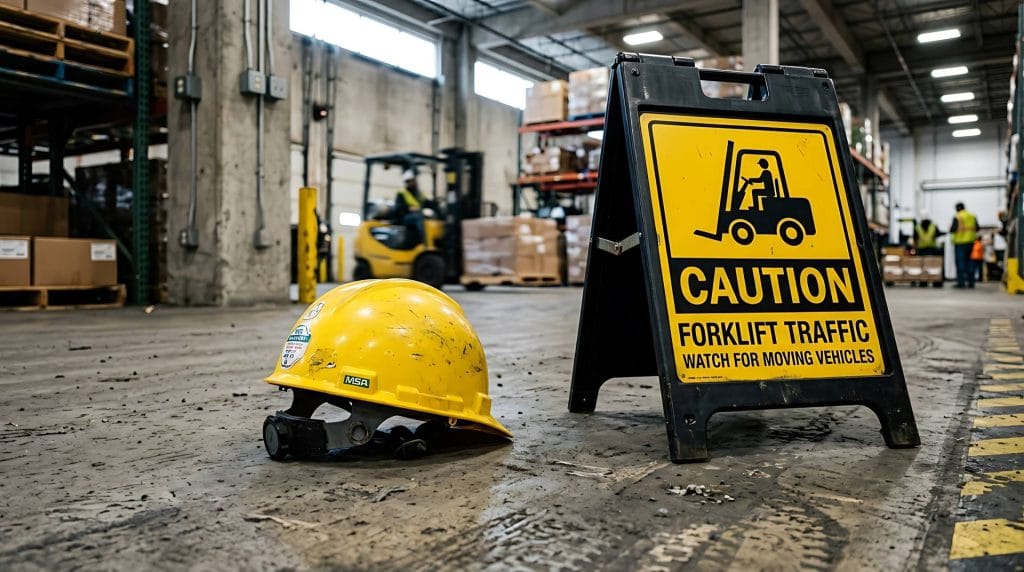
10 Common Workplace Safety Mistakes
Workplace safety is essential for protecting employees, reducing risks, and maintaining legal compliance. However, many South African businesses…
Many South African business owners believe that having a first aid box, fire extinguishers and a few safety signs means their company is compliant with occupational health and safety requirements.
Unfortunately, compliance goes much further than that.
The Occupational Health and Safety Act 85 of 1993 places duties on employers to provide and maintain, as far as reasonably practicable, a working environment that is safe and without risk to employees’ health. The Act also addresses risks that business activities may create for people other than employees.
Whether you operate a construction company, factory, warehouse, office, school, workshop or logistics business, you need to understand the hazards created by your activities and ensure appropriate controls are in place.
The question is:
If an Occupational Health and Safety Inspector arrived at your premises today, would you be ready?
Use the following checklist as a starting point.
One of the foundations of an effective health and safety system is understanding the hazards employees are exposed to.
Employers should identify hazards associated with their workplace, equipment, substances, work activities and processes and implement appropriate measures to eliminate or reduce the risks.
Depending on your operation, hazards may include:
A generic risk assessment downloaded from the internet is unlikely to adequately address the specific risks within your organisation.
Your risk assessments should reflect the activities actually taking place in your workplace.
Identifying hazards is only the beginning.
The next question is whether your business has documented risk assessments covering its significant activities.
A good risk assessment should identify:
Risk assessments should also be reviewed when circumstances change, including when new machinery, equipment, chemicals, work processes or activities are introduced.
The OHS Act specifically requires employers to take reasonably practicable steps to address workplace hazards and inform employees about hazards and the precautions they need to follow.
Once risks have been identified, employees need clear instructions on how work should be performed safely.
This is where Safe Work Procedures become important.
Procedures may be required for activities such as:
Having a procedure sitting inside a file is not enough.
Employees need to understand the procedure and supervisors need to ensure it is implemented.
Training is one of the most important components of occupational health and safety.
Employees should understand:
The OHS Act requires employers, as far as reasonably practicable, to make employees aware of the hazards relating to their work and the precautions they need to take.
Depending on your workplace, additional competency-based training may also be necessary.
Examples include:
Training requirements should always be determined according to the activities, workforce and risks of the organisation.
Health and Safety Representatives play an important role in monitoring workplace conditions and raising safety concerns.
Under the OHS Act, employers with more than 20 employees at a workplace are required to designate health and safety representatives, subject to the requirements of the Act.
Simply giving someone the title of “Safety Rep” is not enough.
The representative should understand their duties and should be able to participate meaningfully in the organisation’s safety programme.
Every workplace should consider how employees will receive immediate assistance when an injury occurs.
The applicable General Safety Regulations contain requirements for first aid facilities and trained first aiders.
Where more than 10 employees are employed at a workplace, the regulations require steps to ensure appropriately certified first aid personnel are available, with the required ratios depending on the type of workplace and employee numbers.
Employers should therefore check:
Do not wait for an accident before discovering your first aid arrangements are inadequate.
What would happen if there were a fire at your premises right now?
Would employees know:
Emergency planning should reflect the actual risks in your workplace.
Fire equipment, evacuation arrangements, emergency contacts, employee awareness and emergency team responsibilities should all form part of your overall safety management programme.
Personal Protective Equipment should be linked to the hazards identified through your risk assessment.
Depending on your operation, this may include:
But providing PPE is only part of the solution.
Employees must understand when PPE is required, how to use it correctly, its limitations and how to care for it.
Remember: PPE should support your risk controls — it should not replace proper hazard management.
A workplace can be compliant today and unsafe next month.
Equipment deteriorates. Employees develop unsafe habits. Fire extinguishers expire. Emergency exits become obstructed. Documents expire. New hazards are introduced.
That is why regular workplace inspections are important.
Inspections can identify problems before they result in an injury, enforcement action or operational disruption.
A good inspection programme should not simply identify problems. Findings should be recorded, allocated to responsible people and tracked until they have been closed out.
Every incident should be treated as an opportunity to prevent something more serious from happening.
Companies should have procedures for reporting and investigating:
Certain occupational accidents and diseases also have formal reporting and compensation requirements. The Department of Employment and Labour provides processes for reporting workplace accidents to the Compensation Fund.
A proper investigation should determine why the incident happened, rather than simply blaming the employee involved.
Corrective actions should then be implemented and monitored.
Occupational health and safety management should also consider Compensation Fund obligations.
The Department of Employment and Labour states that employers are required to register with the Compensation Fund when employing workers covered by the legislation.
Businesses should ensure that their:
COIDA compliance should not only be checked when a client asks for a Letter of Good Standing.
One of the most common problems businesses experience is not necessarily having no documentation — it is having documentation that has not been maintained.
Common examples include:
Your safety documentation should tell the story of how health and safety is actually managed in your organisation.
If you answered “No”, “I’m not sure” or “We need to check” to several of the questions above, it may be time for a professional compliance assessment.
Health and safety compliance should not only become a priority when:
A proactive system is far more effective.
SHEQ Culture Consulting and Training assists businesses with practical occupational health and safety solutions designed around their actual operations.
Our services include:
Our objective is simple:
Identify your compliance gaps, help you correct them and build a safety system that works in the real world — not just on paper.
Don’t wait for an inspection or serious incident to discover the gaps in your safety system.
Contact SHEQ Culture Consulting and Training today to arrange an OHS compliance assessment and find out exactly where your organisation stands.
For more workplace safety tips and updates, take a look at our Facebook and Instagram pages.
SHEQ Culture Consulting and Training
Building a stronger culture of safety, compliance and accountability.
This article provides general information and should not be treated as a substitute for an assessment of the legislation, regulations and requirements applicable to a specific workplace or industry.

Need help putting these insights into practice? Sheq Culture offers tailor-made health and safety training, auditing and consulting for organisations across South Africa.
Let’s work together to build a safer, smarter, and more compliant future for your organisation.